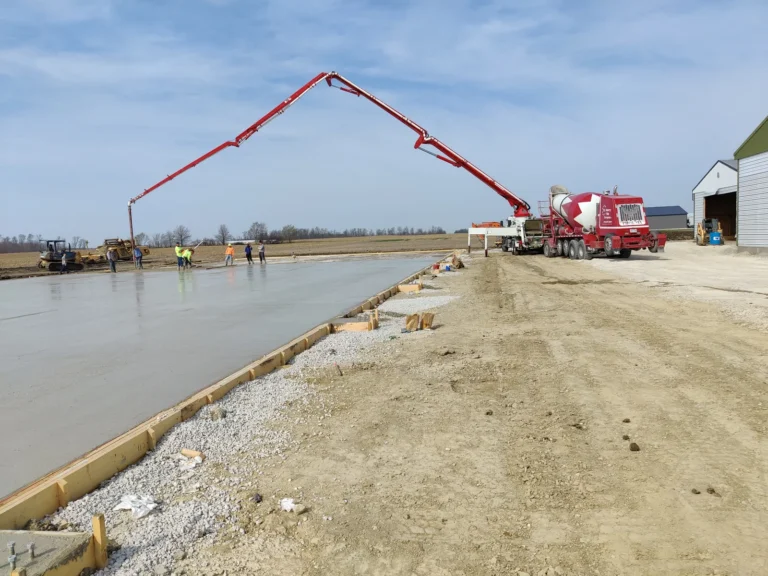
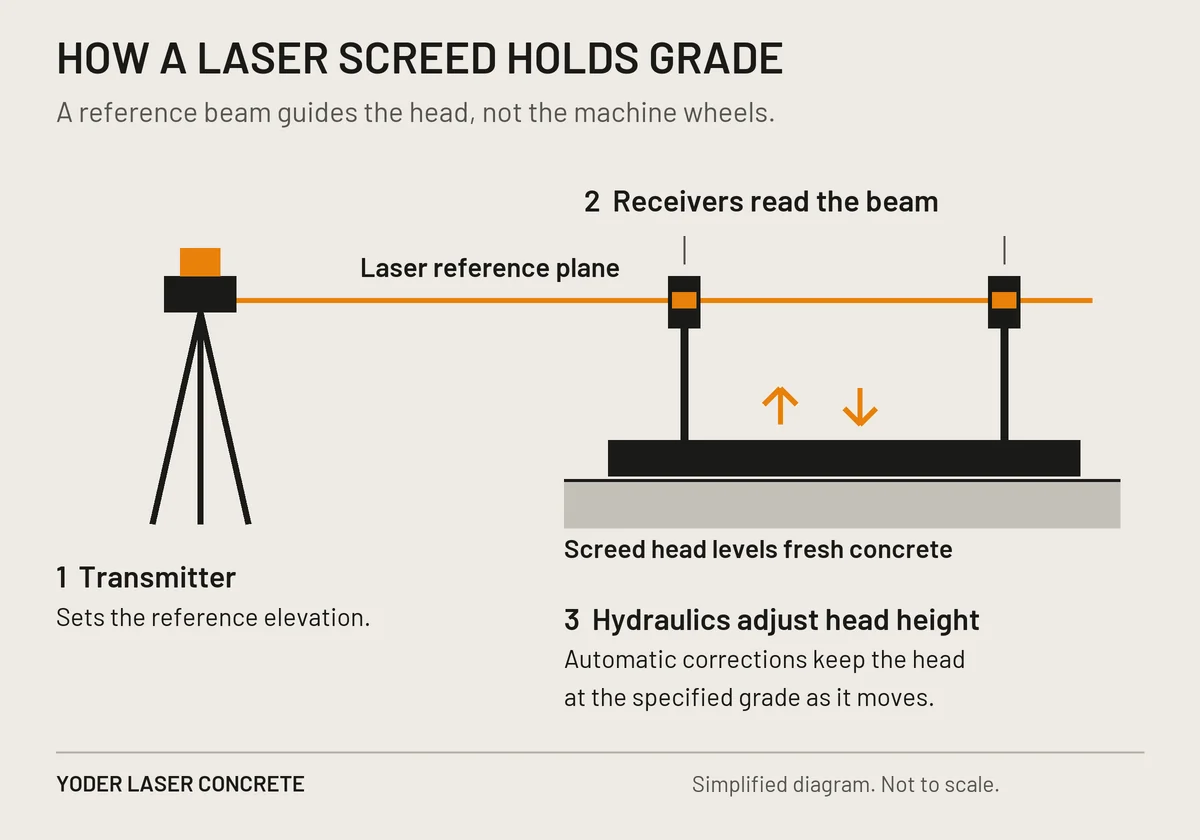
A laser screed is a machine that levels freshly placed concrete to a set elevation. A laser transmitter set up on site sends out a flat reference beam, receivers on the screed head read that beam many times a second, and the machine raises or lowers the head on its own as it pulls through the concrete.
The result is a slab placed to a consistent grade across the pour, which is why laser screeds are widely used for warehouse floors, distribution centers and other large concrete slabs on grade. The main benefits are flatter floors, faster placement, fewer construction joints and less corrective work.
Benefits at a glance:
- Flatness: automatic grade control helps crews meet the floor specification.
- Speed: wider placements reduce the need for narrow screed strips.
- Fewer construction joints: larger pour sections can mean fewer separate placements.
- Less rework: a more consistent strike-off can reduce later grinding and patching.
How a laser screed works
Every screed does the same basic job: it strikes off wet concrete to the right height so the finishers start from a flat surface. A hand screed does it with a straight board or a vibrating bar riding on forms or wet screed rails, and the crew checks those elevations with a level. A laser-guided concrete screed adjusts the head automatically as it strikes off the concrete.
- The reference. A rotating laser transmitter on a tripod beside the pour sets a flat (or sloped) reference plane over the whole area.
- The receivers. Receivers on masts at each end of the screed head read the beam and tell the machine’s controls where the head sits relative to grade.
- The head. A plow cuts the concrete down to rough grade, an auger spreads the excess, and a vibrating strike-off consolidates and levels the surface as the head moves.
- The correction. Hydraulics adjust each end of the head continuously, so the screed holds grade even when the concrete in front of it is uneven.
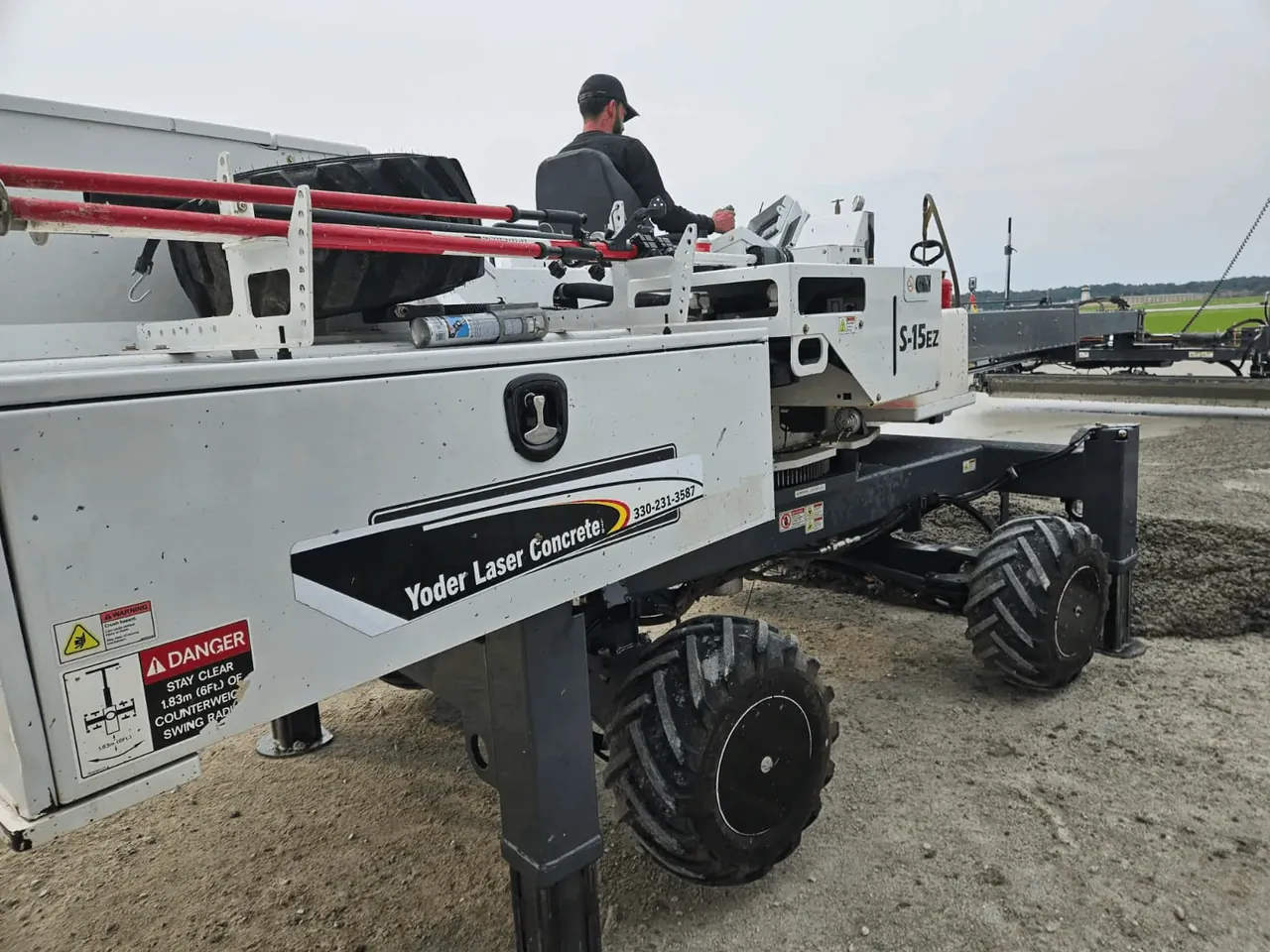
Common types include boom, ride-on and walk-behind laser screeds. Boom machines, such as the Somero S-15EZ, pull the head toward the chassis on a telescoping boom. Drive-in ride-on machines carry the head ahead of the chassis, while compact walk-behind models suit areas with restricted access. The choice depends on pour size, access and the placement plan. Where a slab needs designed slopes or crowns, a 3D laser screed follows a 3D model of the surface instead of a single flat plane.
The benefits of laser screed concrete
Flatter, more level floors
The biggest reason owners specify laser screed placement is flatness. Floor flatness and levelness are measured with FF and FL numbers, and racking, forklifts and automated equipment all depend on them. Because the screed holds grade across the full width of the pour, the floor does not drift between hand-set screed rails. On our warehouse work we treat FF 50 / FL 35 as a baseline. The specified result still depends on the placement and finishing crew, and it must be checked by floor testing. Our guide to FF and FL numbers explains what those figures mean.
Larger pours with fewer joints
A hand screed crew often works in strips between forms or screed rails. A laser screed can place wider areas in one pour, so the slab can need fewer construction joints between separate placements. That can mean fewer joint edges to maintain under forklift traffic. It does not remove the need for designed control joints in the concrete; their spacing and saw-cut timing still matter.
Less corrective work
High spots left by a poor strike-off usually get ground off after the slab cures, and low spots collect water and cause racking to lean. Getting the grade right at placement can reduce later grinding and patching. Crews still need to check the surface and correct local defects before finishing.
Better use of the crew
The machine does the heaviest, most error-prone part of placement. That frees the crew to focus on consolidation, finishing and curing, which are what decide how the floor wears.
How fast does a laser screed work?
Fast enough that the screed is rarely what limits the day. On a large warehouse pour the pace is usually set by how quickly ready-mix trucks arrive, how many finishers are on the slab and how fast the concrete is setting in that day’s weather. A laser screed crew can place a large slab section in a single pour that a hand screed crew would split into several days of strips. Our crews place over a million square feet of commercial concrete a year with this equipment.
How long does a laser screed concrete floor take?
The placement itself happens in one day per pour section, but the whole floor takes longer because of the work around it:
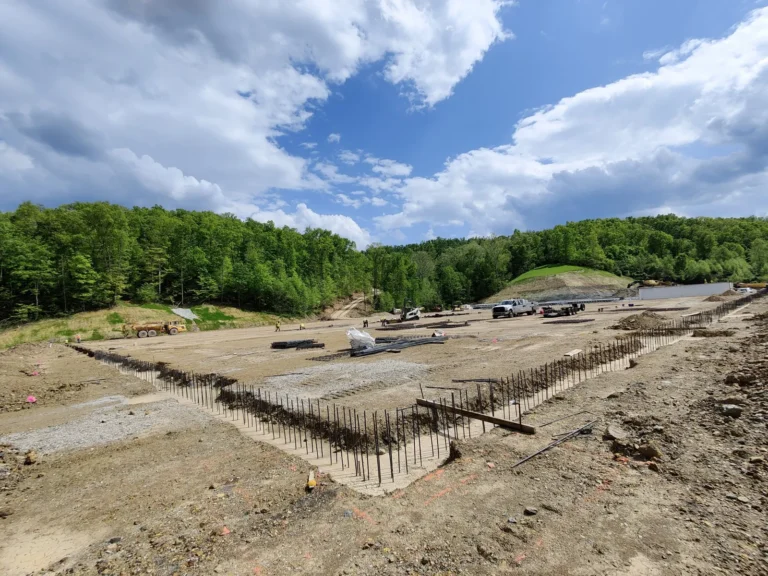
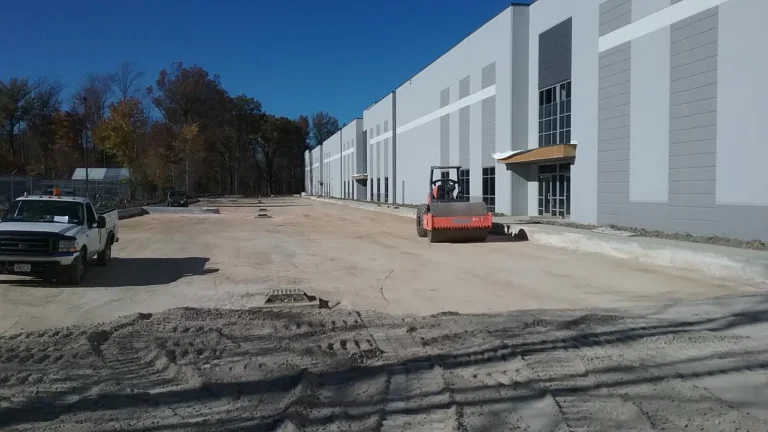
- Before the pour: subgrade compaction, the stone base, edge forms, any vapor retarder, and the reinforcing or dowels the design calls for.
- Pour day: placement with the laser screed, then floating and power troweling the same day as the concrete sets.
- Within hours: saw cutting the control joints, usually the same day or night, before the slab starts to crack on its own.
- The following week: curing, with light foot traffic after a day or two and vehicles once the concrete reaches the strength the engineer specifies.
Laser screed vs hand screed and other methods
| Method | How grade is set | Best suited to |
|---|---|---|
| Hand or straightedge screed | Forms or wet screed rails checked with a level | Small pours, tight spaces, repairs |
| Vibratory or roller screed | Rides on forms on each side of a strip | Small to medium slabs poured in strips |
| Laser screed | Laser reference read by the machine, adjusted automatically | Large concrete slabs on grade where flatness and placement speed matter |
Laser screed concrete uses the same concrete mix specified for the slab. The difference is how crews place and level it. Hand screeding can be the practical choice for small or obstructed pours; laser screeding helps maintain grade over large, open areas. Both methods still need proper consolidation, finishing, jointing and curing.
When a laser screed is not the right tool
Laser screeds pay off on large, open areas. For small pours, tight rooms full of columns or short pieces of flatwork, the mobilization costs more than it saves, and a good hand crew is the better answer. That is why we take on laser screed work from about 10,000 square feet up.
Does laser screeding reduce concrete floor costs?
On a large, open slab, faster placement and less corrective grinding can offset the cost of mobilizing the machine. On a small or difficult-to-access pour, those savings may be limited. There is no single laser screed cost per square foot that fits every job.
Compare the complete floor scope: slab area and thickness, access, concrete supply, reinforcing, the FF/FL specification, finishing, jointing and curing. For the material portion, our concrete cost per yard guide explains what ready-mix pricing includes. Machine purchase and rental prices are different from the price of an installed floor.
Does a laser screed replace finishing or prevent cracks?
No. It levels and vibrates fresh concrete during placement. Crews still float and trowel the surface, cut the specified joints and cure the slab. Laser screeding does not change the concrete strength specified in the mix design or guarantee a crack-free floor.
Planning a large slab?
Yoder Laser Concrete places warehouse floors and industrial slabs with our own Somero laser screeds across Ohio, Indiana, Michigan, West Virginia and Pennsylvania. See our warehouse floor work, or send us your plans and an estimator will reply within 24 hours. For background on the equipment itself, Somero builds the laser screeds most crews use.