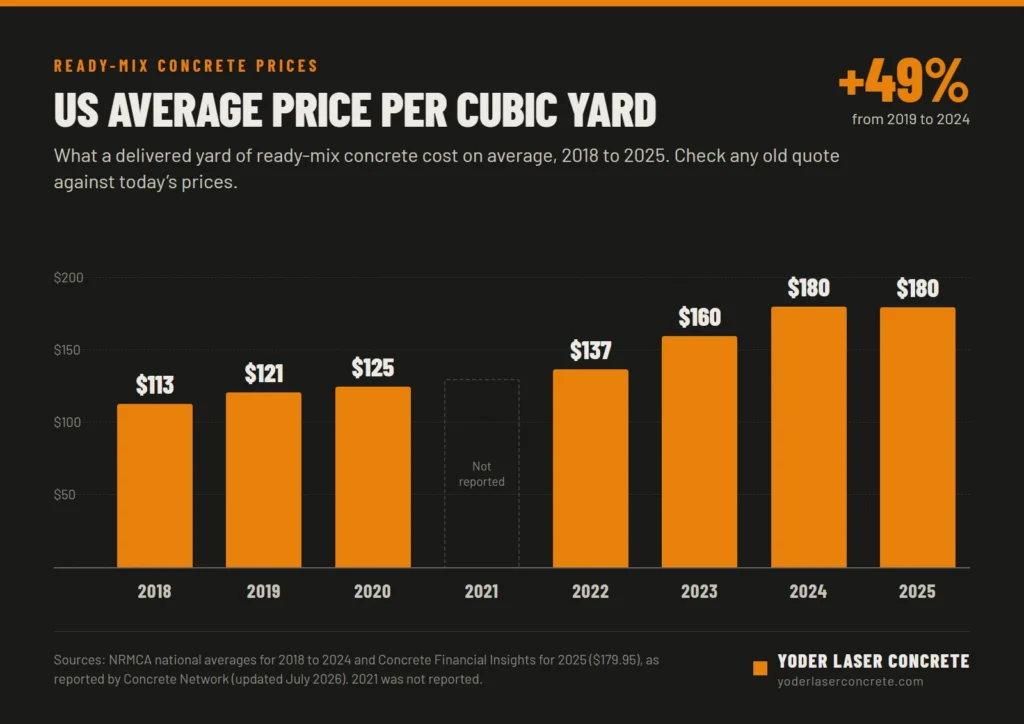
Ready-mix concrete costs about $160 to $195 a cubic yard delivered in most of the United States in 2026, and the national average in 2025 was about $180 a yard, according to Concrete Network’s price survey (updated July 2026). Ohio ready-mix plants quote job by job rather than publishing price lists, so the price you pay depends on the plant, the distance and the mix. Delivery distance, small loads, winter heating and the mix you order all add to the base price, so the invoice is usually higher than the number on the quote sheet. To work out how many yards you need and what they cost, use our concrete calculator.
What a yard of concrete costs in 2026
| Measure | Price per cubic yard | Source |
|---|---|---|
| Typical US range, 2026 | $160 to $195 or more | Concrete Network, July 2026 |
| US average, 2025 | $179.95 | Concrete Network, citing Concrete Financial Insights |
| US average, 2024 | $180 | NRMCA, as reported by Concrete Network |
| US average, 2019 | $121 | NRMCA, as reported by Concrete Network |
Concrete got a lot more expensive in a short time: the national average went from $121 a yard in 2019 to $180 in 2024, a rise of about half. Prices are still creeping up. The producer price index for ready-mix concrete rose 2.3 percent from September 2025 to September 2026 (U.S. Bureau of Labor Statistics, via FRED). A price you were quoted two or three years ago is almost certainly low today.
What one yard covers
A cubic yard is 27 cubic feet. How much floor that makes depends on the thickness:
| Thickness | Square feet per cubic yard |
|---|---|
| 4 inches | 81 |
| 5 inches | 65 |
| 6 inches | 54 |
| 8 inches | 40.5 |
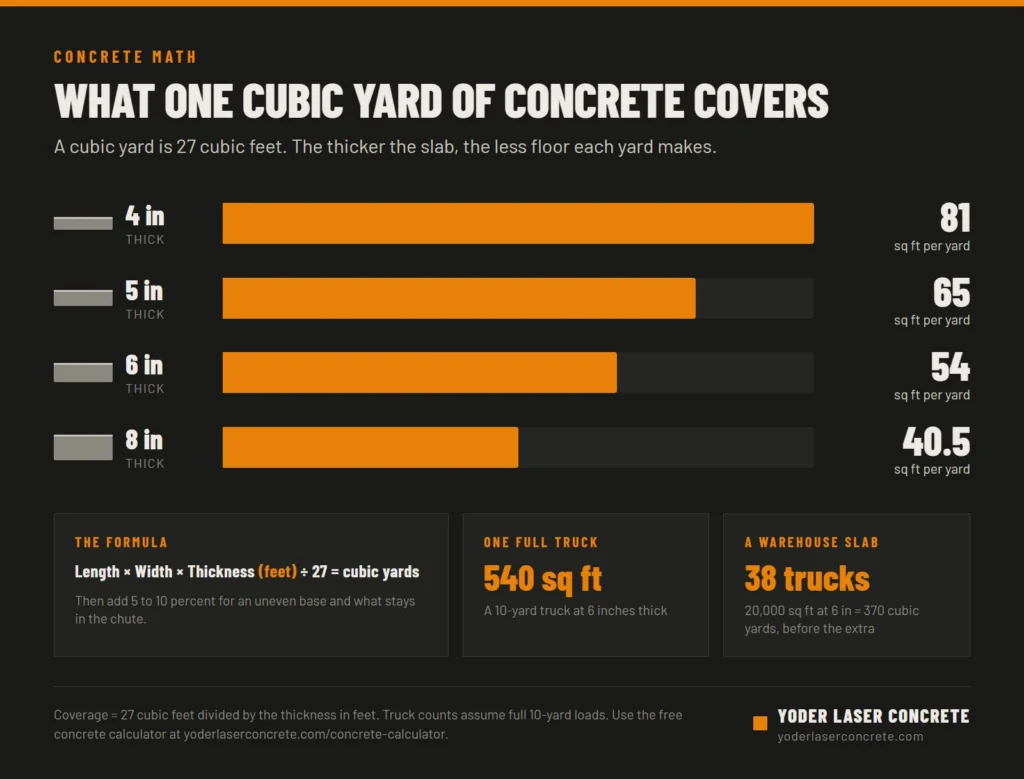
To size a pour, multiply length by width by thickness, all in feet, and divide by 27. A 30 by 40 foot shop floor at 4 inches (a third of a foot) is 30 x 40 x 1/3 = 400 cubic feet, or 14.8 yards. Order 5 to 10 percent extra to cover an uneven base and what stays in the chute, so call it 16 yards. A 20,000 square foot warehouse slab at 6 inches takes about 370 yards before the extra, which is 38 full trucks.
What adds to the delivered price
The price per yard on a supplier’s sheet is the starting point. These are the charges that usually come on top:
- Delivery distance. Most plants include delivery within a set distance and charge more beyond it. Rural jobs far from a plant pay for the drive.
- Small loads. A full mixer truck carries up to about 10 yards. Orders under the plant’s minimum carry a short-load fee, so ask for the minimum and the fee when you get the quote.
- The mix. Higher strength means more cement and a higher price. Outdoor concrete in Ohio should be air entrained to survive freeze and thaw cycles, and fibers or special admixtures add cost.
- Winter. Heated water and aggregates, and accelerating admixtures, are extra in cold months. Our guide to pouring concrete in cold weather explains what they do.
- Time. Saturday, holiday, early-morning and after-hours deliveries usually cost more, and so does a truck kept waiting on site past the unloading time the plant allows.
- Surcharges. Many plants add a fuel or environmental charge per load.
- Placing equipment. A concrete pump or conveyor is a separate rental from the concrete itself.
Price per yard vs installed price
The concrete is only part of what a finished slab costs. Concrete Network puts a plain concrete slab, materials and labor, at $6.50 to $10.50 a square foot in 2026. At $180 a yard, the concrete itself works out to about $2.22 a square foot in a 4-inch slab and $3.33 a square foot in a 6-inch slab. The rest pays for site preparation and the stone base, forms, reinforcement, placing and finishing, curing, saw-cut joints and the equipment and crew to do it.
That gap is why two bids for the same slab can differ by more than the cost of the concrete. The thickness, the strength and the base under it matter as much as the price per yard. For a warehouse floor, our guide to warehouse slab thickness, PSI and joints covers what drives those choices.
Why prices vary across Ohio
- Distance from the plant. The same mix costs more 40 miles out than 5 miles out.
- Local materials. Cement, sand and stone prices differ from one region of the state to another.
- Season. Spring and summer are the busy months, when plants are booked up. Our post on Ohio’s construction season covers how to plan around it.
- Order size. Full trucks avoid short-load fees, and large orders are priced differently from small ones.
Buying concrete for a large commercial pour
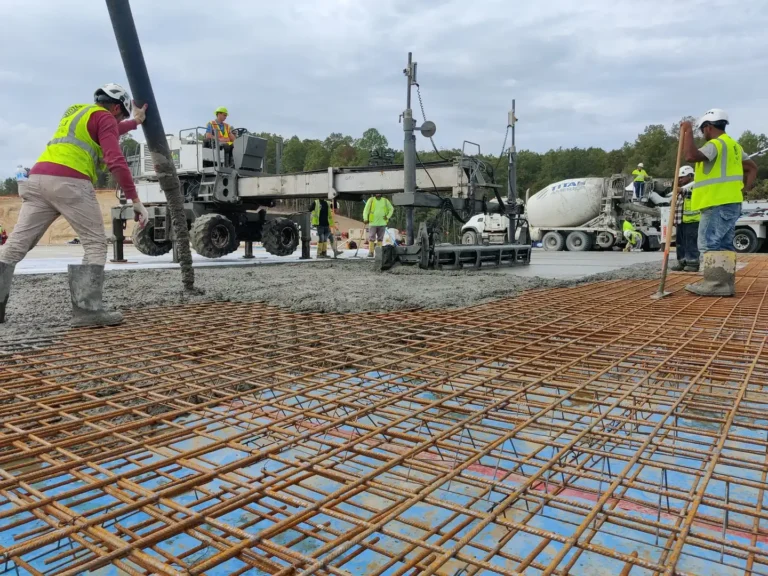
On a big job the price per yard is agreed with the plant ahead of time, usually as part of the project bid, and it is not the only thing that matters. A 20,000 square foot slab at 6 inches is about 38 truckloads. The plant has to batch steadily and keep trucks arriving at the pace the crew can place and finish concrete, because a gap between trucks can leave a cold joint or an uneven surface. On large floors we place with a laser screed, which places far more square footage in a day than hand screeding, so the trucks have to keep up with it.
The mix comes from the project specification. Warehouse floors are commonly specified around 4,000 psi, and exterior paving in Ohio around 4,000 psi with entrained air. We pour over 1 million square feet of commercial concrete a year across Ohio, Indiana, Michigan, West Virginia and Pennsylvania.
Frequently asked questions
How much is a 10-yard truck of concrete?
At $160 to $195 a yard, a full 10-yard truck is about $1,600 to $1,950 of concrete before delivery charges and fees.
Is there a minimum order for ready-mix concrete?
Plants will usually deliver small loads, but anything under their minimum carries a short-load fee. Ask for the minimum and the fee before you order, because on a one or two yard job the fee can be a large part of the bill.
How much more does 4,000 psi concrete cost than 3,000 psi?
It costs more per yard because it carries more cement. The difference depends on the plant, so ask for both prices on the same quote. Warehouse floors and Ohio exterior paving are commonly specified around 4,000 psi.
How many square feet does a yard of concrete cover?
81 square feet at 4 inches thick, 65 at 5 inches, 54 at 6 inches and 40.5 at 8 inches.
Is concrete cheaper per yard on a large order?
Full trucks avoid short-load fees, and large commercial orders are priced by agreement with the plant rather than from a price list. On a big job the price is set by the project, its schedule and the plant’s capacity.
Pricing a commercial slab?
If you are pricing a slab of 10,000 square feet or more, send us the plans and an estimator will reply within 24 hours. For a quick number on any size of pour, the concrete calculator gives you the yards, the truckloads and a material cost to take to your local plant.