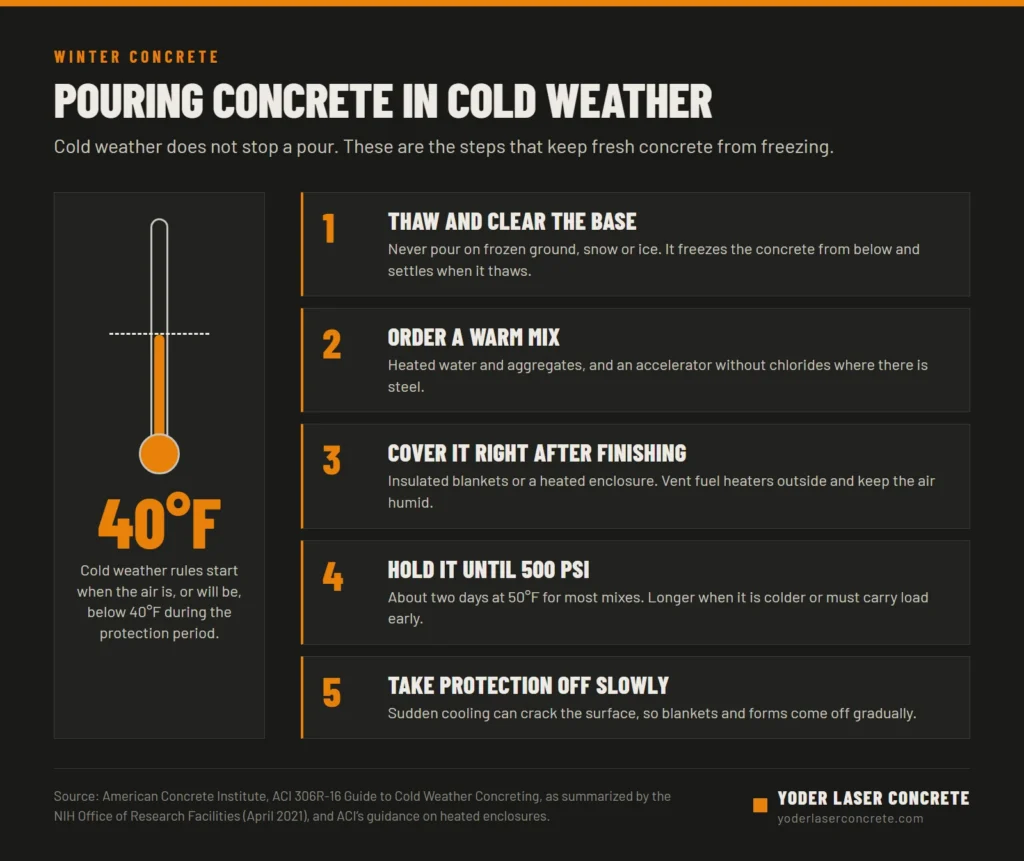
Concrete can be poured in cold weather, and in Ohio a lot of it is, but below 40 degrees the pour needs a plan. The American Concrete Institute counts it as cold weather when the air temperature has fallen, or is expected to fall, below 40°F during the protection period. Fresh concrete then has to be kept from freezing until it reaches about 500 psi, which takes about two days for most concrete held at 50°F. The two hard rules are simple: never pour on frozen ground, and never let the new concrete freeze before it has gained that strength.
How cold is too cold to pour concrete?
There is no single air temperature where concrete work stops. What matters is the temperature of three things:
- The air over the days after the pour, not just the morning of it. A 45-degree afternoon followed by a 20-degree night is a cold weather pour.
- The concrete. Thin sections such as slabs, footings and walls lose heat faster than massive ones, so they need to arrive warmer and be kept warmer.
- The ground and forms. Concrete placed on frozen ground, snow or ice freezes from below, and frozen subgrade settles when it thaws, taking the slab or footing with it.
So too cold is whatever temperature the crew cannot protect against. With warm concrete, a thawed base and the right cover, pours go ahead well below freezing.
Why cold is hard on fresh concrete
Concrete hardens through a chemical reaction between cement and water, and that reaction slows down as the temperature drops. Near freezing it almost stops. If the water in fresh concrete freezes before the concrete has reached about 500 psi, the ice expands inside the paste and the damage is permanent: the concrete can lose a large share of the strength and durability it was designed for. Once it is past that point and kept protected, the cold slows it down but does not ruin it.
What changes in the mix
- Heated water and aggregates. The plant heats the materials so the concrete leaves the plant warm.
- Accelerating admixtures. They speed up the set and early strength. Accelerators without chlorides are used where there is reinforcing steel, because chlorides corrode it.
- More cement or high-early-strength cement. Either one gains strength faster.
- Air entrainment for anything that will sit outside. It protects the finished concrete through Ohio’s freeze and thaw cycles; it does not protect fresh concrete from freezing.
- A lower water content, so there is less water to freeze and less bleed water to wait on.
Protecting the pour
- Thaw and cover the base first. Ground heaters or insulated blankets thaw the subgrade before the pour, and the base must be free of snow and ice.
- Insulated blankets. For footings, walls and slabs on grade, blankets hold the concrete’s own heat in. They go on as soon as finishing allows.
- Heated enclosures. Tarps or temporary walls around the work, with heaters inside, for colder weather or for work that needs to be finished in the open.
- Vented heaters and moisture. Fuel-fired heaters are vented outside, because carbon dioxide in their exhaust reacts with fresh concrete and leaves a soft, dusty surface. The air inside an enclosure is kept humid so the surface does not dry out.
- Temperature checks. Thermometers or sensors in the concrete show whether it is staying warm enough, rather than guessing from the weather report.
How long to protect it
The minimum is until the concrete reaches about 500 psi, which is about two days at 50°F for most mixes and longer in colder concrete. Anything that has to carry load early, such as a wall that will be backfilled or a slab that trucks will drive on, needs protection until it reaches the strength the engineer specifies, which takes longer still. Crews confirm strength with test cylinders cured on site or with maturity sensors in the pour, not with the calendar.
Protection also comes off gradually. Pulling blankets off warm concrete on a cold, windy day cools the surface faster than the inside and can crack it. Forms often stay on longer in winter for the same reason. Our post on how long concrete takes to cure covers the strength timeline in normal weather.
What winter does to the schedule and the cost
- Materials. Heated concrete and accelerators cost more per yard. Our guide to what a yard of concrete costs lists the usual winter charges.
- Equipment. Blankets, heaters, fuel and enclosures are a line item of their own.
- Time. Finishing takes longer when concrete sets slowly, and protection adds days before the next trade can start.
- Weather days. A hard freeze or a storm can still move a pour by a day or two.
None of that is a reason to stop a project for the winter. A building that waits for spring loses months, and the first warm weeks of the year are when every crew and plant in Ohio is booked. Our post on Ohio’s construction season covers how bids and starts line up across the year.
What we pour all winter
Yoder Laser Concrete pours footings and walls on new buildings all winter, and we take on warehouse and factory floor tear-outs and replacements all winter too. Footings and walls keep a new building moving toward spring, and a floor replaced in the slow months is ready before the busy season starts.
Frequently asked questions
Can you pour concrete in winter in Ohio?
Yes. Concrete is poured through Ohio winters with warm concrete, a thawed base and blankets or heated enclosures. The work costs more and takes longer than in mild weather, but it keeps projects on schedule.
What is the minimum temperature to pour concrete?
There is no single cutoff. Cold weather precautions start when the air is, or will be, below 40°F during the protection period. Below that, concrete can still be poured if it is placed warm and kept from freezing until it reaches about 500 psi.
Can you pour concrete on frozen ground?
No. Concrete on frozen ground freezes from below and settles when the ground thaws. The ground is thawed and covered first, and any snow or ice is removed.
Do concrete blankets work?
Yes, for slabs, footings and walls in moderate cold. They hold in the heat the concrete makes as it cures. In deep cold, crews add heaters or build an enclosure.
How long should concrete blankets stay on?
At least until the concrete reaches about 500 psi, about two days at 50°F for most mixes, and longer when it is colder or the concrete has to carry load early. They come off gradually so the surface does not cool too fast.
Planning winter work?
If you need footings, walls or a floor replaced this winter, call (330) 231-3587 or send us the plans and an estimator will reply within 24 hours. The cold weather figures above come from the American Concrete Institute’s guide ACI 306R, as summarized in the National Institutes of Health technical bulletin on cold weather concreting, and ACI’s guidance on heated enclosures.