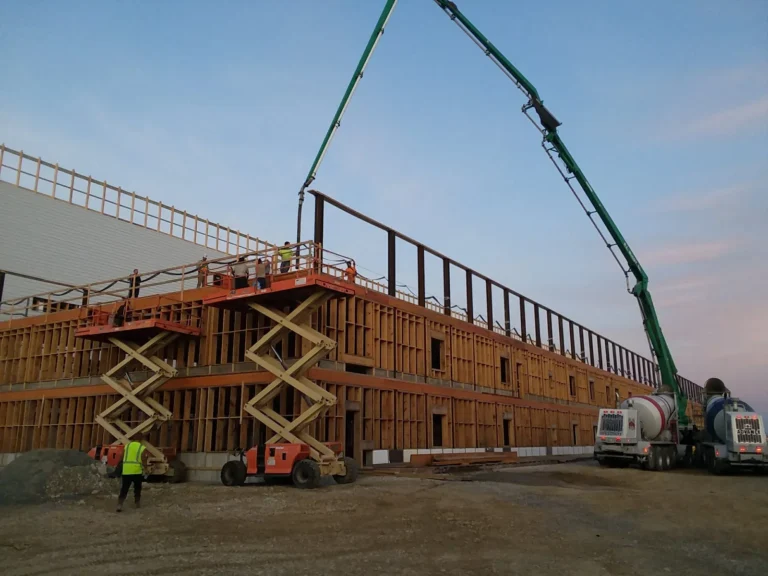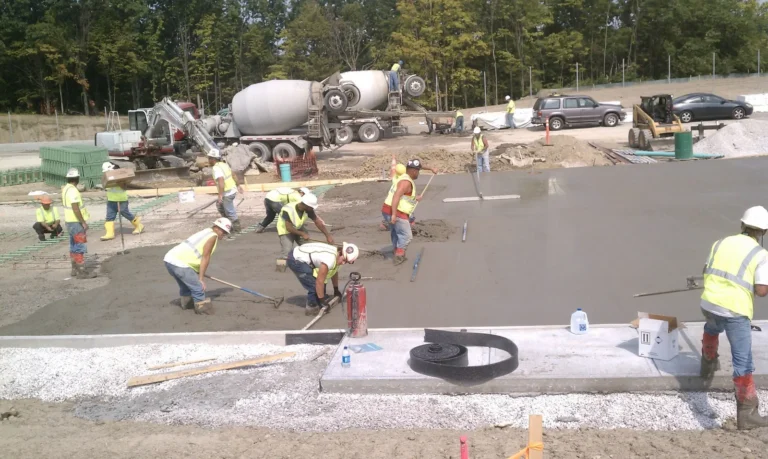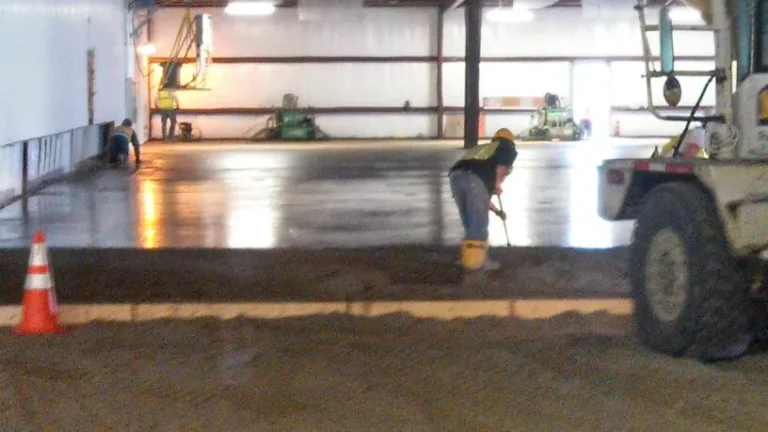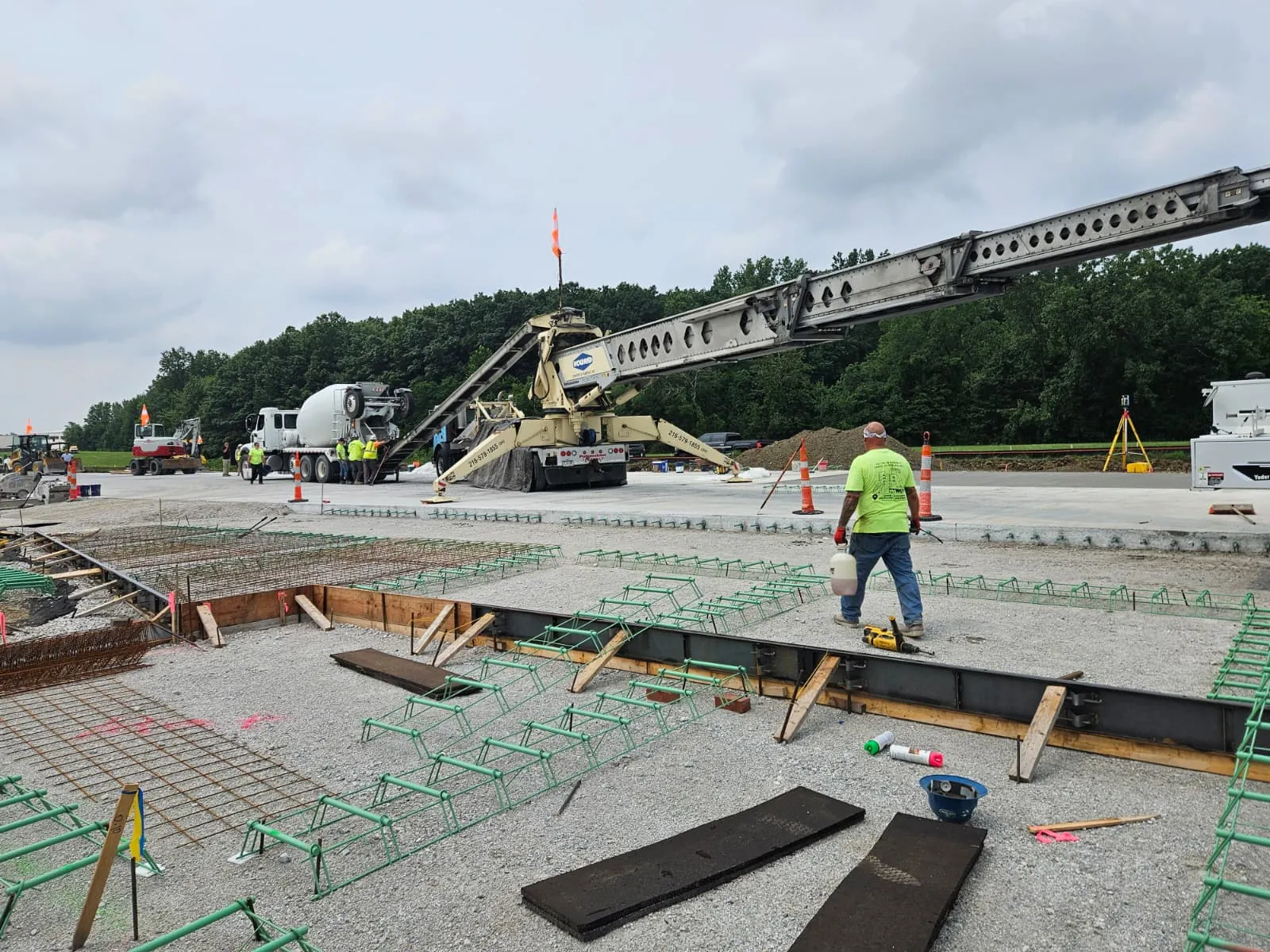
A standard ready-mix truck carries up to about 10 cubic yards of concrete. Plenty of loads go out smaller, because the truck’s legal road weight, the mix and the plant’s own rules decide the real load, not just the size of the drum. One full 10-yard truck makes about 540 square feet of slab at 6 inches thick, so a 20,000 square foot warehouse floor takes about 38 truckloads. To work out your own pour, use our concrete calculator.
How much concrete a truck holds
The familiar ready-mix truck, with the turning drum and the chute at the back, is built to carry up to about 10 cubic yards. Smaller trucks carry less, and the plant will also send part loads when that is all a job needs.
Concrete is heavy, and that is the real story behind the number. According to the National Ready Mixed Concrete Association, normalweight concrete weighs 140 to 150 pounds per cubic foot. A cubic yard is 27 cubic feet, so each yard weighs roughly 3,800 to 4,050 pounds. Ten yards is about 19 to 20 tons of concrete before you count the truck and the drum.
Why a truck is not always full
- Road weight limits. On the Interstate, the federal limits are 80,000 pounds gross, 20,000 pounds on a single axle and 34,000 pounds on a tandem axle, according to the Federal Highway Administration. State and local roads can be stricter. A loaded mixer is very heavy for its length, so the axle limits often decide the load before the drum is full.
- The mix. A denser mix weighs more per yard, so the same truck carries fewer yards of it.
- The plant and the site. Plants set their own maximum loads for their trucks and routes. A soft or tight site, a weight-posted bridge or a long climb can mean smaller loads.
- The last truck. On most pours the final load is a partial one, ordered once the crew knows exactly how much is left.
What a truckload of concrete costs
At the 2026 range of about $160 to $195 a cubic yard, a full 10-yard truck is roughly $1,600 to $1,950 of concrete before delivery charges and fees. Loads under the plant’s minimum carry a short-load fee, so on a small job it often pays to ask for the minimum and the fee before you order. Delivery distance, winter heating, the mix and the time of day can all add to the bill, as our guide to how much a yard of concrete costs in Ohio explains.
How many trucks a slab needs
Work it out in three steps: multiply the area in square feet by the thickness in feet, divide by 27 to get cubic yards, then divide by 10 and round up to get full truckloads. A 6-inch slab is half a foot thick, so 10,000 square feet x 0.5 = 5,000 cubic feet, which is 185 cubic yards, or 19 trucks.
| Slab area | Cubic yards at 6 inches | Full 10-yard trucks | With 5 percent extra |
|---|---|---|---|
| 2,500 sq ft | 46 | 5 | 49 yards, 5 trucks |
| 10,000 sq ft | 185 | 19 | 194 yards, 20 trucks |
| 20,000 sq ft | 370 | 38 | 389 yards, 39 trucks |
| 50,000 sq ft | 926 | 93 | 972 yards, 98 trucks |
| 100,000 sq ft | 1,852 | 186 | 1,944 yards, 195 trucks |
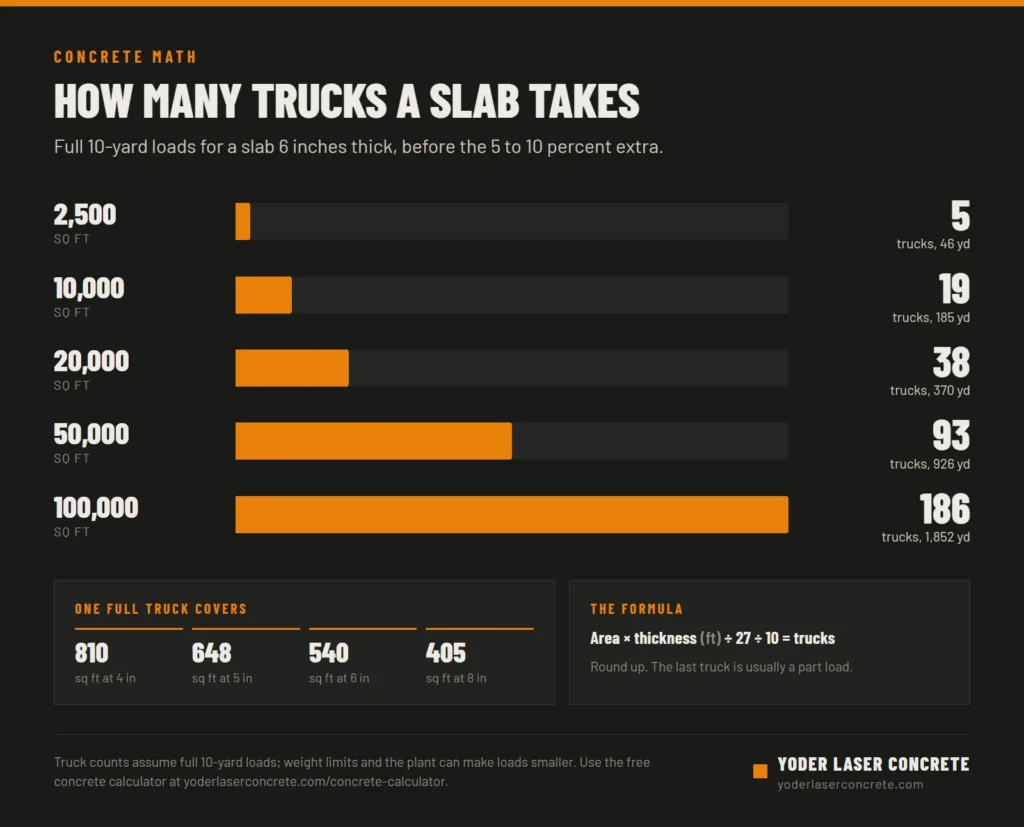
Thickness changes the answer quickly. One full 10-yard truck covers about 810 square feet at 4 inches, 648 at 5 inches, 540 at 6 inches and 405 at 8 inches. Order 5 to 10 percent extra to cover an uneven base and what stays in the chute. The concrete calculator does all of this for slabs, footings and walls.
Keeping trucks moving on a big pour
On a 10,000 square foot floor and up, the number of trucks matters less than the rhythm. Concrete has to keep arriving at the pace the crew can place and finish it, because a long gap between trucks can leave a cold joint or an uneven surface where fresh concrete meets concrete that has started to set.
- Plan the pour with the plant. The order, the start time and the spacing between trucks are agreed before the day, along with a backup if a truck breaks down.
- Give the trucks a route. A firm way in, a place to wait and a way out keeps trucks from blocking each other. A washout area for the chutes is part of the site plan.
- Watch the clock on each load. Concrete has a limited working time in the drum. The long-standing rule of thumb is 90 minutes from batching to discharge, and the job’s specification and the producer set the limit that applies.
- Let the placing pace set the order. On large floors we place with a laser screed, which places far more square footage in a day than hand screeding, so the plant has to batch steadily and the trucks have to keep up with it.
We pour over 1 million square feet of commercial concrete a year across Ohio, Indiana, Michigan, West Virginia and Pennsylvania, and on a warehouse floor that means planning dozens of trucks so the slab goes down in one even, continuous pour.
Frequently asked questions
How many yards are in a full concrete truck?
Up to about 10 cubic yards in a standard ready-mix truck. Weight limits, the mix and the plant’s rules often mean a smaller load.
How much is a 10-yard truck of concrete?
At 2026 prices of about $160 to $195 a yard, a full 10-yard truck is about $1,600 to $1,950 of concrete, before delivery charges and fees.
How many square feet does a truck of concrete cover?
About 540 square feet at 6 inches thick, 810 at 4 inches and 405 at 8 inches, for a full 10-yard load.
How many trucks of concrete do I need?
Multiply the area by the thickness in feet, divide by 27 for cubic yards, then divide by 10 and round up. A 20,000 square foot slab at 6 inches takes about 38 trucks before the extra.
How much does a full concrete truck weigh?
The concrete alone in a 10-yard load weighs about 19 to 20 tons, and the truck and drum add a lot more. That is why road weight limits, not the size of the drum, often set the load.
Can a concrete truck deliver less than a full load?
Yes. Plants send part loads, but anything under their minimum carries a short-load fee, so ask for the minimum before you order.
Planning a large pour?
For a quick number on any size of slab, footing or wall, the concrete calculator gives you the yards, the truckloads and a material cost. If you are pouring 10,000 square feet or more, send us the plans and an estimator will reply within 24 hours.